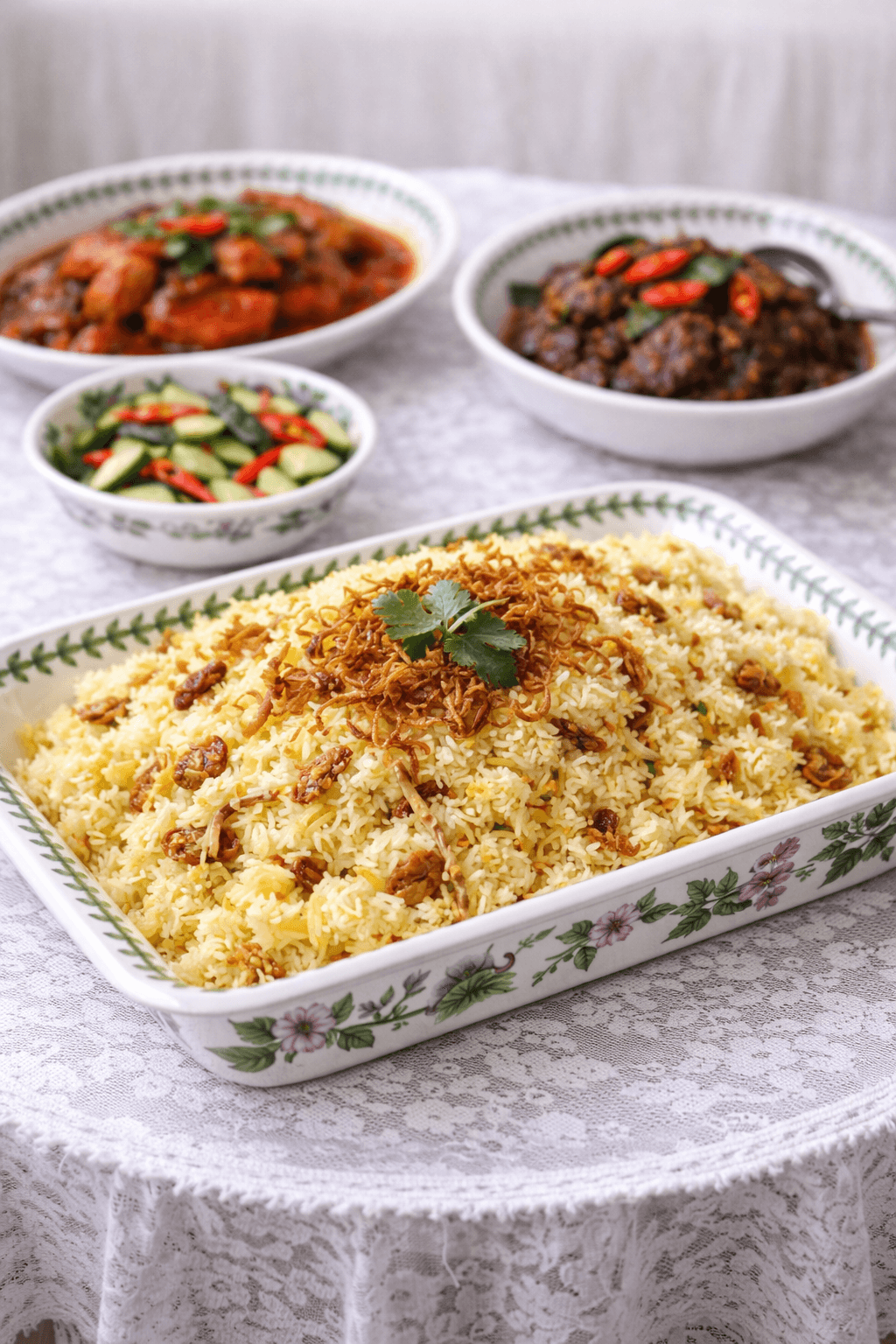
What We Put on the Table
What we put on the table is never just food. It’s memory, habit, and a quiet way of teaching our children how to move through the world. This essay reflects on Malaysian dishes, everyday dinners, and the belief that comfort comes from familiarity built over time, not from avoiding difference.
On Monday, our kitchen smelled like turmeric and fried shallots. Indonesian nasi kuning, yellow rice warm with spice, is the kind of food that settles into the house before you sit down.
Since then, the week has unfolded the way weeks do.
There were burgers one night.
Miso cod and rice, another, clean and quiet and precise.
Tonight it is dumplings, steam rising as they come off the pan.
Nothing unusual. Nothing staged. Just how we eat.
Food has always been one of the quiet ways we teach our children how to move through the world. Long before they have language for culture or difference, they learn through taste what is familiar, what is welcome, and what does not need explaining.
When my son Liam was in second grade, he was asked to write about his favorite food. Most kids wrote about pizza, chicken nuggets, and mac and cheese. The narrow comfort of beige. Pale pastas, pale breads, pale sauces. Food designed to avoid surprise.
Liam wrote egg and rice.
Not framed as special. Not explained with an apology. Just what he understood as comfort. Day-old rice fried with butter, eggs, garlic, soy sauce, and black pepper. A simple Asian dish made in countless homes when nothing fancy is planned and everything needs to feel grounding. He described it plainly, the way you explain something you do not realize might be unfamiliar to someone else.
That answer told me more about our household than any parenting philosophy ever could.
In countless homes here in the U.S., “kids’ food” becomes a narrowing. A slow shrinking of flavor and curiosity in the name of ease. But comfort is not born from avoidance. Comfort is mastery. Comfort is familiarity earned through repetition and joy.
Our boys know that.
Comfort food here has never been about color or category. It is about fluency.
Now that they are older, their cravings have expanded rather than contracted. Their idea of comfort is often a bowl of clear fishball noodle soup, wide rice noodles, springy fishballs, and a broth that tastes clean and anchoring. They also love burgers, wings, and a good steak. Miso cod disappears quickly. Dumplings are never left behind. Eli will happily choose fish and chips. Tacos, Mediterranean food, curries. None of it feels foreign enough to require commentary.
Malay food, especially, lives easily at our table.
Ayam goreng is met with immediate enthusiasm. Nasi lemak needs no explanation. Coconut rice, sambal, anchovies, egg. Familiar and grounding in a way that does not fade with time. Liam loves sambal. Not cautiously. Properly. He understands heat as part of flavor, not something to negotiate away.
And every year, without exception, we look forward to rendang at Eid. Slow, dark, unapologetic. The kind of dish that takes hours and patience and gives something back that convenience never could. In our house, it is simply understood to be one of the best foods in the world.
Even breakfast follows the same rhythm.
Some mornings it is scrambled eggs and turkey bacon. Sometimes corned beef. And other mornings it is Turkish shakshuka, eggs poached in tomato and spice, or what they still call circle bread, roti prata, torn by hand and dipped into chicken curry. No special occasion required. No translation needed.
There is no sorting here between kids’ food and adult food.
No dividing line between what is normal and what is foreign.
There is just food.
This way of eating is a choice.
It is a rejection of blandness. Not just of spice level, but of imagination. Of the idea that food should flatten itself to be acceptable. Of the belief that familiarity must come from sameness.
Over time, this has changed all of us. My husband will say now that his palate has expanded, that he notices flavor differently. He can tell when something has depth and when it has been flattened, diluted, made polite. He knows when food tastes like it knows where it comes from.
And right now, that kind of knowing matters.
We are living in a moment where fear is loud. Where difference is treated as suspect. Where racism feels less coded and more comfortable saying its name out loud. I now leave the house carrying my passport. Not because it feels reasonable, but because it feels necessary. Because being brown in public has started to come with calculations I did not use to make.
I do not want my children absorbing that fear as normal.
I want them to understand, deeply and instinctively, that the world is not something to narrow in response to threat. That difference is not a problem to be managed. That curiosity is not naive. It is essential.
Each meal at our table teaches something subtle but profound.
That people live differently, and that this is not a threat.
That unfamiliar flavor is an invitation, not a barrier.
That comfort can come from curry and clear soup alike.
One dish I return to often is nasi minyak, fragrant Malay festive rice, rich with ghee and spice, traditionally served at celebrations. Years ago, my version of it was featured in a Foodista cookbook. In our house, it has never been ceremonial or precious. It is familiar. It is grounding. It is part of the everyday language of home.
This is how we raise our boys. Not through speeches about inclusion, but through daily practice. Through repetition. Through taste.
I do not need them to be impressed with themselves for being cultured.
I just want them to be at ease.
At ease in homes that do not look like theirs.
At ease at tables where they do not recognize everything immediately.
At ease with the idea that the world is wide, and that widening yourself is safer than shrinking.
It starts here.
With what we put on the table.
————————————————————————————————————————————————
Nasi Minyak (Serves 4)
This is a dish I make to remember.
Nasi minyak is fragrant, Malay festive rice, familiar and grounding. It belongs at a full table, one that moves slowly and makes room.
Ingredients:
Rice
2 cups basmati rice
Water, for soaking and cooking
Aromatics & Fat
3 tablespoons ghee (or a mix of ghee and neutral oil)
1 medium onion, thinly sliced
2 cloves garlic, lightly crushed
1 inch ginger, bruised
Whole Spices
1 cinnamon stick
3 green cardamom pods
3 cloves
1 star anise
Liquid & Seasoning
2½ cups water or chicken stock
1 pandan leaf, knotted (optional but very Malay)
½ teaspoon salt (adjust to taste)
1 teaspoon sugar
Finish
2 tablespoons evaporated milk or full-fat milk
1 tablespoon rose water or kewra water (optional, but traditional)
Fried shallots, for garnish
Method
Wash and soak the rice.
Rinse the basmati until the water runs clear. Soak for 20–30 minutes, then drain well. This matters. It gives you long, separate grains.Fry the aromatics
In a heavy pot or rice cooker insert, heat the ghee over medium heat. Add the sliced onions and cook slowly until soft and lightly golden. You want sweetness, not crispness.Bloom the spices
Add garlic, ginger, cinnamon, cardamom, cloves, and star anise. Stir gently until fragrant. The kitchen should smell warm and familiar, not sharp.Add rice and liquid
Add the drained rice and stir to coat every grain in the spiced fat. Pour in the water or stock, add pandan leaf, salt, and sugar. Stir once.Cook the rice
Bring to a gentle boil, then cover and lower the heat. Cook for 12–15 minutes until the liquid is absorbed and the rice is tender. If using a rice cooker, switch to “cook” and let it do its thing.Finish with milk and aroma.
Once cooked, drizzle the evaporated milk and rose or kewra water over the rice. Gently fluff with a fork. Cover and let it rest for 5 minutes.Serve
Transfer to a serving dish and top with fried shallots.
To Serve
Nasi minyak pairs well with dishes that carry depth and contrast. We usually serve it with ayam masak merah, rendang, and paceri nenas, letting the richness, heat, and sweetness balance each other. A simple cucumber salad or acar on the side is enough.
Published:
Jan 16, 2026