Italian Beef, Far From Home
This is a recipe that took weeks before it took heat. It begins with leaving one place and learning what doesn’t follow you, noticing how certain foods hold entire seasons inside them, and how difficult they are to remake elsewhere. What follows moves between memory and method, attention and action, what can be replicated and what can’t. The recipe is exact. The outcome is not.
We moved to California in 2018, trading Chicago winters for light that looks almost theatrical by comparison. The kind of sun that makes you forget where you came from, if you let it.
But some things don’t forget you.
My husband misses an Italian beef sandwich.
Not in a dramatic way. He doesn’t complain about it. He doesn’t romanticize Chicago the way people sometimes do when they leave. It shows up in smaller moments, trying deep dish here and realizing it isn’t the same, or when fall arrives without the weight it carries in the Midwest. No real cold. No long gray stretch. None of that enclosed, inward feeling winter brings with it back east.
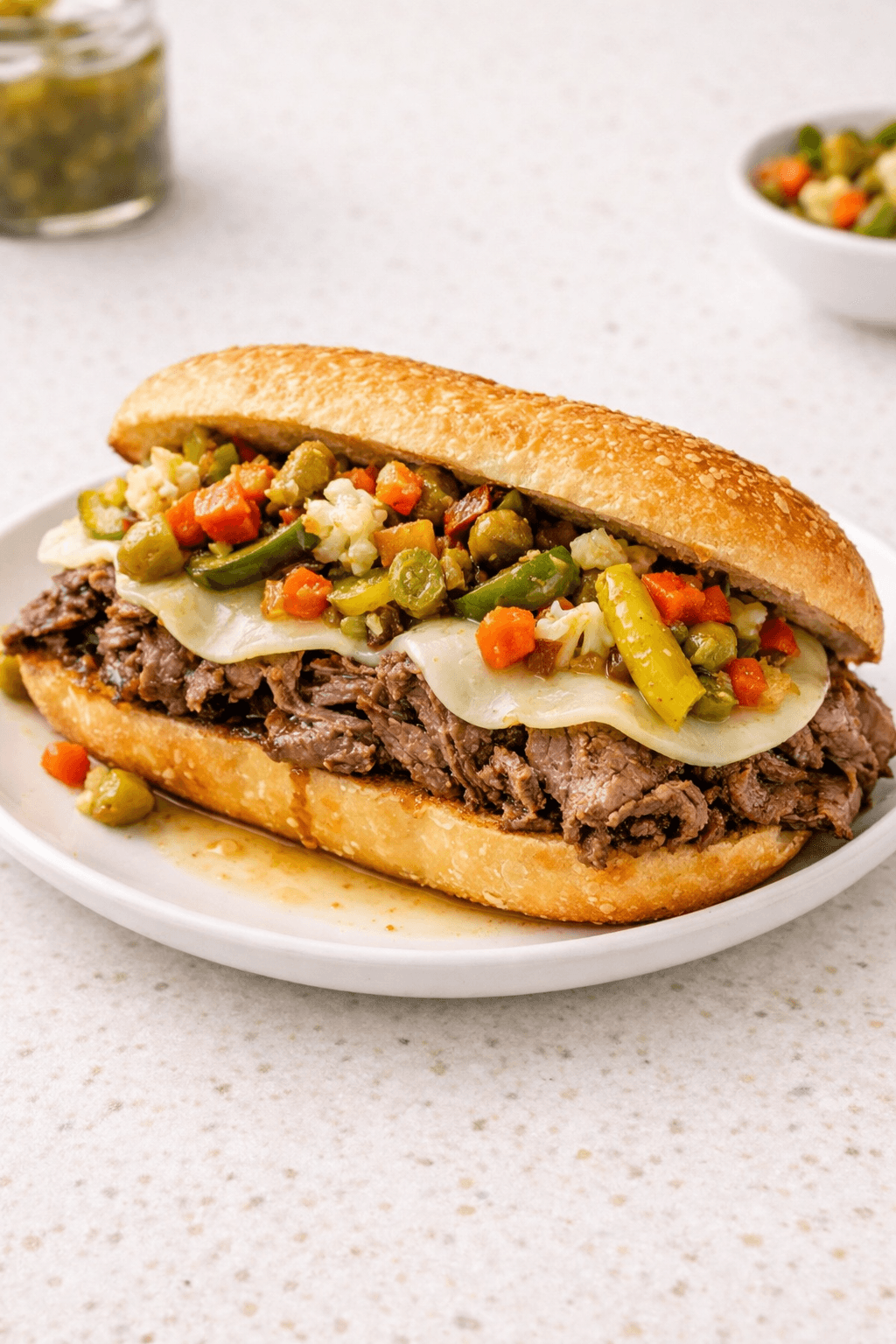
Chicago Italian beef is specific. Messy. Thinly sliced. Dipped, not drizzled. It’s eaten standing up, leaning forward, paper wrapped tight around it like a promise you know won’t hold. It’s not nostalgic food, it’s practical, working food. The kind you miss without realizing you’re missing it.
California doesn’t really do that kind of sandwich.
I decided to try anyway.
The decision came weeks before Christmas, long before I touched a pot or turned on the stove. It lived in the background at first, tabs left open, videos half-watched, recipes saved and unsaved again.
Italian beef is one of those things people speak about with certainty. TikTok cooks. Food Network chefs. Bloggers who swear theirs is the only correct version. I watched, rewound, and compared. I even went back to The Bear, pausing scenes as if something might slip through if I looked closely enough.
Everyone sounded sure.
No one sounded the same.
That felt familiar.
The giardiniera slowed me down. The wrong kind is easy, too mild, too careful. I checked what was available nearby, compared labels, made a few compromises, and landed at World Market. Not ideal. Close enough.
The bread mattered more than I expected. Chicago bread holds when it has no business doing so. I learned quickly that I wouldn’t find that here.
I still tried. I researched, then drove to Safeway with a short list and low expectations. I stood in the bakery aisle longer than necessary, pressing rolls between my fingers, testing their resistance, asking them, quietly, to be something else.
Most of them failed immediately.
I started cooking two days before Christmas. The beef cooked low and slow, rested, then returned to the jus. The work was quiet and deliberate, nothing festive about it yet.
By Christmas Day, most of the effort was already behind me. All that was left was reheating, assembling, paying attention.
Outside, the light was bright and wrong for December. Inside, the house moved more slowly, gifts unwrapped, nowhere else to be. The kitchen filled again with the smell of beef and spices, out of place for Christmas and exactly right at the same time.
The boys drifted in and out, asking questions. Tom stayed nearby, pretending not to care too much.
When we finally ate, it wasn’t Chicago.
But it was close enough to quiet something.
I’m writing this a few days later, with Christmas already behind us, the tree still up but starting to feel temporary. The leftovers are gone. The kitchen smells like itself again.
Sometimes that’s the best you can do, not recreate home, but make space for it. Acknowledge what someone misses, even if you can’t bring it back exactly as it was.
Sometimes love looks like weeks of attention, two days of work, and a sandwich that will never be perfect.
And sometimes, far from where a thing began, that’s enough.
Chicago-Style Italian Beef (A California Attempt)
Serves: 6–8
This is not fast food. Plan ahead.
This version works best when made over two days, even if the dry brine is shorter. The flavor deepens with rest.
Ingredients
For the beef
4 lb chuck roast
1 tbsp Maldon sea salt (crushed lightly between fingers)
2 tbsp high-smoke-point oil (avocado oil or similar)
Au Jus
8 cups low-sodium beef stock
4 cloves garlic, roughly chopped
4 tbsp butter
1 tbsp celery salt
1 tbsp black pepper
1 tsp red pepper flakes (use less if sensitive to heat)
1 tbsp garlic powder
2 tsp ground coriander
1 tbsp fennel
1 tbsp smoked paprika
1 tbsp dried basil
1 tbsp dried oregano
1 tbsp dried thyme
1 tbsp dried rosemary
3 whole bay leaves (kept separate)
½–¾ cup pepperoncini liquid (from the jar)
Pepperoncini peppers, lightly crushed or torn (to taste)
For serving
French rolls (sturdy matters more than softness)
Giardiniera (hot, preferably)
Chicago-style sweet peppers oven roasted with garlic, black pepper, and salt drenched in olive oil (optional)
Provolone cheese (optional)
Method
Dry Brine (Same Day)
Pat the chuck roast dry with paper towels. Trim any large pieces of exposed fat or silver skin. Season generously on all sides with Maldon sea salt, crushing it slightly as you go so it adheres evenly.
Let the roast sit uncovered at room temperature for 1½–2 hours. This isn’t a long dry brine, but it seasons the meat and helps with browning.
Cook the Beef
Preheat the oven to 325°F.
In a small bowl, combine all dried spices except the bay leaves.
Heat a large, heavy-bottomed pot or Dutch oven over medium-high heat. Add the oil and sear the roast on all sides until deeply browned. Let it release naturally before turning. Remove the roast and set aside.
Lower the heat and carefully wipe out excess oil, leaving the browned bits. Add butter to the warm pan and let it melt. Stir to lift the fond.
Add the spice mixture to the butter and cook gently for 1–2 minutes, until aromatic. Add the chopped garlic and cook another minute.
After returning the roast to the pot and coating it in the spiced butter, pour in the beef stock and pepperoncini liquid. Add the bay leaves and a handful of pepperoncini peppers, lightly crushed. The liquid does not need to fully cover the meat.
Bring to a gentle simmer, then transfer the uncovered pot to the oven.
Roast for 3–3½ hours, until the internal temperature reaches 190–195°F. The meat should be tender, but not shreddable.
Rest and Chill
Remove the pot from the oven and let it cool at room temperature for about an hour. Then refrigerate the beef in the jus, uncovered or loosely covered, overnight.
This step matters. The meat needs to fully chill to slice properly.
Slice and Finish
The next day, remove the pot from the fridge. Do not skim the fat — it carries flavor.
Heat the jus gently on the stove. Remove the roast and slice it as thinly as possible against the grain. This takes time. Go slowly.
Add small batches of sliced beef back into the simmering jus and heat for about 10 minutes.
Assemble
Slice the rolls. Pile the beef generously, ladle over extra jus, and top with giardiniera. Add sweet peppers or provolone if you want them.
Some prefer the whole sandwich dipped briefly into the jus. That part is personal.
Eat leaning forward.
A note
This won’t be Chicago.
It’s something made with attention, far from where it started.
That counts.
Published:
Dec 28, 2025